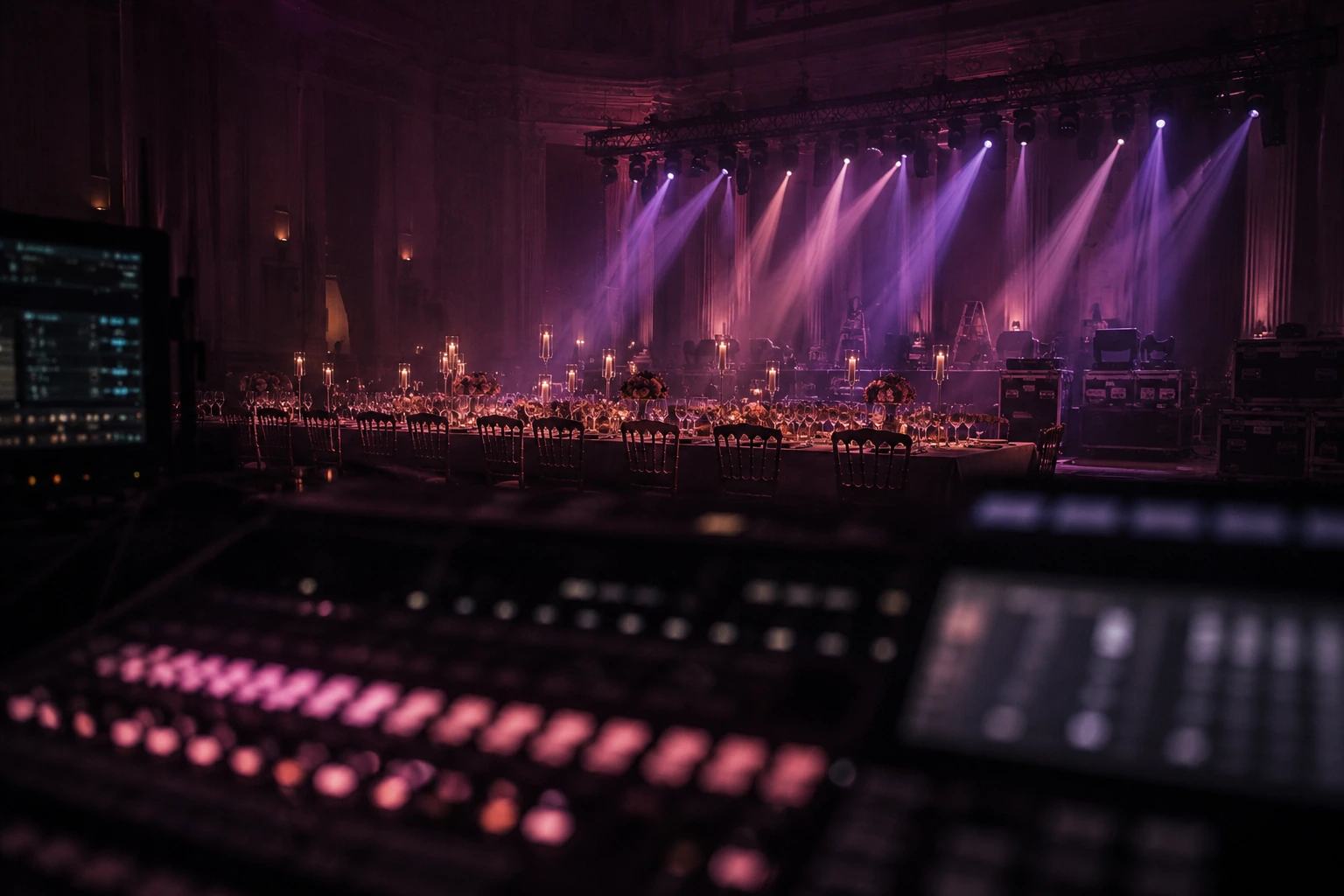

What does technical production include at a corporate event?
It covers everything the guest hears and sees that was not in the room when the doors opened. AV means the sound and the screens. Lighting takes in the stage, the room and the building, and staging adds the platform, the set and the backdrop. Nobody photographs the Getting enough electricity to the right points on a site, which historic buildings and outdoor spaces rarely have already., the Hanging lights, sound and scenery above the guests, and proving the structure can hold the weight. or the The hours before an event when trucks arrive and everything is carried in and built, which is when most venue restrictions bite. that puts it all in place. Five trades share one schedule, and the producer owns it.
| Format | Guests | On site as standard | Added for larger, heritage or hybrid versions |
|---|---|---|---|
| Conference | 50 to 300 | Front-of-house audio, wireless presenter microphones, main-stage LED or projection, confidence monitors, stage lighting, mixing console and technician | Rear projection, multi-screen, LED walls, interpretation booths, live stream with multi-camera and a remote audio mix |
| Gala dinner | 80 to 400 | Sound, light, screens and scenery for the room | In a heritage room: lighting, projection and controlled guest movement instead of a heavy scenic build |
| Product launch | 30 to 300 | Staging and a reveal sequence, with media movement and same-day content | Installations, neon staging and live performance for a brand activation |
Hybrid formats add a second audience. A conference that streams needs multi-camera capture, a remote audio mix, moderated remote questions and a broadcast feed. BTQ Events rehearses the stream separately from the room, because a room that sounds fine to the people in it can sound hollow to colleagues watching from a desk.
How much of an event budget is technical?
On a premium gala, technical production takes about a third of the budget. In BTQ Events production data, 2026, a €55,000 evening for 100 guests spends €18,100 on sound, light, screens and scenery. Food and drink is €15,000. The room and its furniture are €9,000, and only €4,000 of that is the venue fee.
The technical line follows a different rule. Food, seats and coaches scale with the guest list, but the stage, the light design, the sound system and the technician serve the room. Their cost barely moves between 80 guests and 100. So the technical share rises as a dinner gets smaller, and a 60-guest awards night can carry a higher share than a 300-guest one.
What moves the technical line, heaviest first
- The building
A palace with no fixings, no flame and no stage power needs floor-standing light, a generator and floor protection. A congress centre has the kit in the walls.
- The programme
An awards show, a live stream or a performance adds cameras, a remote audio mix and more rehearsal. A seated dinner with two speeches does not.
- The hours
A load-in window that opens at 15:00 for a 19:30 dinner buys a smaller set. A late finish adds crew overtime and a The reverse of load-in: taking everything down and off the site after the guests leave, often overnight. after midnight.
- The guest count
More guests mean more speakers and a larger screen, but the console, the designer and the stage are already paid for.
Which technical limits do heritage venues in Portugal set?
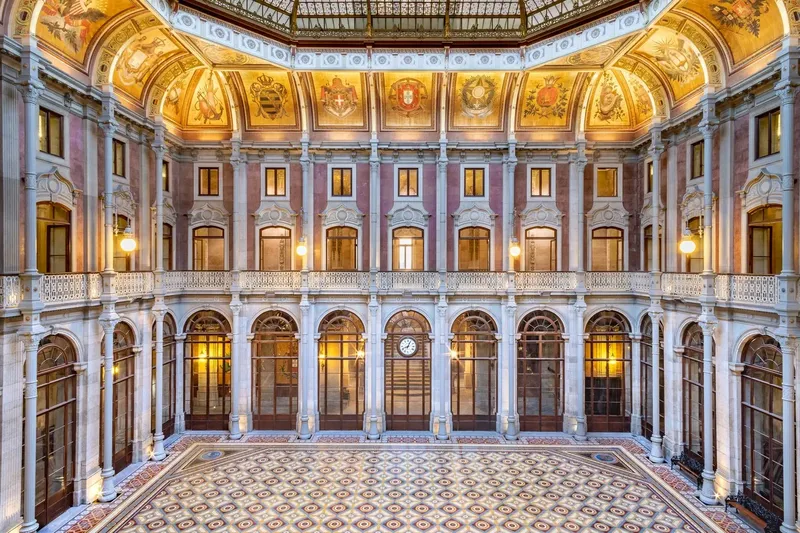
They set more limits than a hotel does, and they put them in writing. The clearest case BTQ Events works with is Palácio da Bolsa in Porto, a neoclassical palace built between 1842 and 1910 and run by the Associação Comercial do Porto. No fixing goes into a wall or surface, and naked flames stay out. Rigs stand on their own feet, with floor protection under anything heavy. Only approved suppliers work inside the building.
Each room adds a rule. The Salão Árabe, with its carved Arabic verses, allows only low-level dimmable warm light and carries a sound cap. The Sala Dourada was not built for amplified speeches, so it takes wireless lavalier microphones and nothing louder. In the Sala Tribunal, staging stands free, with no fixings into the bench.
The Pátio das Nações, under its glass dome, holds 500 for a cocktail and 350 seated, and rewards a radial seating plan. Lighting, projection and controlled guest movement suit the room, and heavy scenic builds and large-format LED walls do not.
The timeline follows the rules. The venue request goes to the association in weeks one and two with the programme, the supplier list, a technical brief, insurance and a risk assessment. The committee answers in about two weeks. Suppliers lock in weeks eight to ten, when the kit is chosen to fit heritage doorways and protected surfaces. The walkthrough takes weeks eleven and twelve, and the night comes fourteen weeks after brief acceptance.
A private estate writes its own limits. Quinta da Bella Vista in Sintra holds its glasshouse to 88 dB(A), with a step-down at 23:30 and a hard stop at midnight. BTQ Events times the band, the light plan and the speeches to that clock before designing anything else.
What should you ask about the technical plan before you sign?
Ask these eight questions, and expect written answers in the proposal. A BTQ Events proposal reaches the client within 48 hours of a brief, and its Production and Exclusions sections are where these answers belong. A technical plan that cannot answer them is only a price.
- Where does the power come from, how many circuits, and who owns the distribution on the night?
- What may be rigged above the guests, and which engineer signs it off?
- When does the load-in window open, and when does the room have to be empty again?
- What are the sound limits, in decibels and in clock time, and who holds the limiter?
- What is the backup for the main screen, the main microphone and the main power feed?
- Who sits at the console during the programme, and who calls the The minute-by-minute plan of an event day, naming who does what and when, down to the moment the doors open.?
- If the event streams, where is the stream rehearsed, and who moderates remote questions?
- Which technical items are excluded from the price, and what would each one cost if the brief changes?
The questions come from evenings BTQ Events has produced. The ADB Safegate conference in Lisbon ran five days for 150 guests, gala included, and its main stage carried branded backdrops and a full AV set. The 160-guest masquerade at Palácio do Grilo had a stage, a live band and aerial performers, and its technical build was the largest budget line.
Where does BTQ Events sit relative to an AV supplier?
BTQ Events sits one level above the AV supplier. An AV or technical supplier owns sound, light, staging and the equipment, and its job ends at the technical layer. A production company also owns concept, design, build, hospitality and on-site direction, through the live programme to the handover. BTQ Events is that second kind, and it holds the technical layer inside one production plan, whoever supplies the kit.
The difference shows first in the design. An AV supplier answers the question it is asked, which is how many speakers and how many screens. A producer starts earlier and asks what the room has to do at 21:40, when the award is announced. The about page sets the three roles side by side in one table. On site, it comes down to who decides when the truck is late.
Describe the moments, not the equipment
Say that 150 guests will watch an awards reveal and two speeches, and that a stream goes to 400 colleagues abroad. The supplier builds the kit list from that description.
Send the venue's rules with the brief
List the fixings, flame, sound limits, closing time and load-in window. If the venue has not put them in writing, ask for them before the design starts.
Fix the hours
Confirm when the room opens for the build and when it must be clear. A six-hour window and a sixteen-hour window produce different sets at different prices.
Ask for one technical owner
Name the person who holds power, rigging and the console on the night. In a BTQ Events production the BTQ producer coordinates that person.
Read the exclusions
Generator, overtime, internet, rigging sign-off and a weather plan are the lines most often left out of a first quote. Ask for each one as a priced option.
“Where the guest sees a finished room, the producer sees five trades on one schedule.”
Frequently asked questions
What does AV include at a corporate event?
AV covers sound and screens, meaning front-of-house audio, wireless presenter microphones, a main-stage LED screen or projection, confidence monitors, a mixing console and the technician who runs it. BTQ Events manages lighting, staging, power and rigging alongside it as separate trades in one technical plan.
How much does AV cost for a corporate event in Portugal?
On a premium gala for 100 guests, sound, light, screens and scenery together come to about €18,100 of a €55,000 budget, in BTQ Events production data, 2026. The share rises for smaller dinners and for shows with a stream or an awards programme, because the stage and the console cost about as much for 60 guests as for 100.
Why is technical production so expensive in a palace?
A palace has none of the technical layer built in. At Palácio da Bolsa nothing is fixed to a surface, so light stands on the floor. The building predates stage power, so distribution comes in, and only approved suppliers work inside. The client pays BTQ Events for the design that works around those limits.
What is the difference between an AV company and an event production company?
An AV company stops at the technical layer of sound, light, staging and equipment. A production company such as BTQ Events carries the whole event, from concept and build to on-site direction, and keeps the technical layer inside its own plan.
Can a hybrid conference be produced in a heritage venue?
Yes, if the stream is planned as its own layer. It needs multi-camera capture, a remote mix, moderated questions and a broadcast feed, plus internet, which first quotes often leave out. BTQ Events gives the stream its own rehearsal, apart from the room.
How long before the event does the technical plan need to be fixed?
At a protocol-governed heritage venue such as Palácio da Bolsa, suppliers lock in weeks eight to ten of a fourteen-week timeline, after the venue committee has approved the technical brief. A gala in a hotel ballroom runs on a 12 to 16 week lead time overall. In a BTQ Events production, the technical scope first appears in the proposal sent within 48 hours of a brief.
What technical costs are usually missing from a first quote?
The usual gaps are extra venue hours, the load-in and load-out, crew overtime, rigging and its sign-off, power distribution or a generator, internet, and a weather plan for anything outdoors. Each appears by name in the Exclusions section of a BTQ Events proposal, which keeps the commercial boundary clear before the event.
Sources
- BTQ Events production data, Gala cost structure, conference kit and heritage venue rules (2026)